
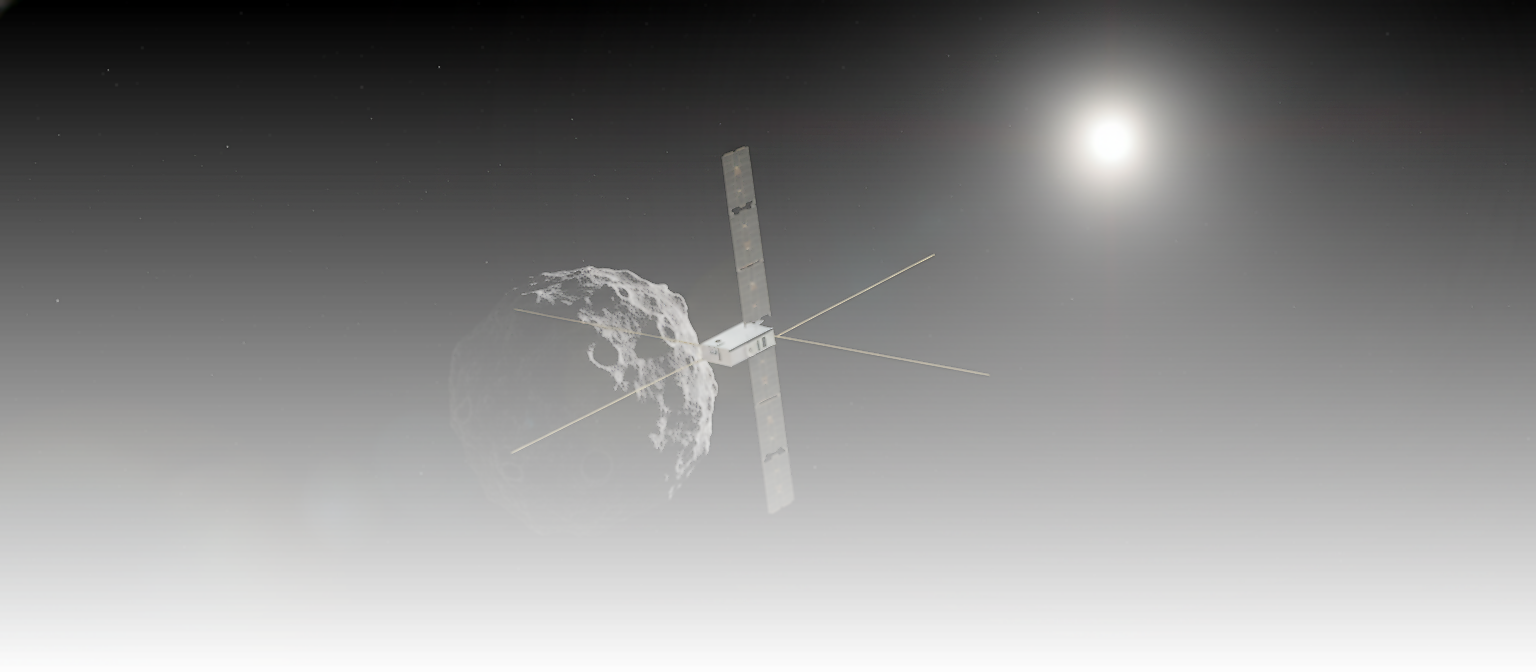
The Hera mission, led by the European Space Agency (ESA), represents a pivotal advancement in planetary defence and asteroid exploration. Launched on Oct. 7, 2024, aboard a SpaceX Falcon 9 rocket from Cape Canaveral, Florida, Hera is on the way to the binary asteroid system Didymos, with an expected arrival in October 2026 following a two-year cruise that includes a Mars gravity assist in March 2025. Hera’s primary objectives include conducting a detailed post-impact survey of Dimorphos, impacted by NASA’s DART on in 2022, to measure the deflection’s effectiveness, demonstrating autonomous navigation and low-gravity proximity operations in deep space, and gathering scientific data on the asteroid system’s composition, structure, and gravity fields. The spacecraft acts as a mothership for two shoe-box sizedCubeSats, Juventas and Milani, which it will deploy upon arrival to perform complementary close-range investigations. Hera itself measure approximately 1.6 m per side, with deployable solar wings spanning 11.5 m and providing around 800 W of power. Its mass is roughly 800 kg at launch. The Hera carries several scientific instruments on board including:
- 2 Asteroid Framing Cameras (AFC) for visible imaging
- Hyperspectral Imager (HyperScout-H) for geological and compositional investigation
- Thermal Infrared Imager (TIRI) for thermal surface mapping
- Laser Altimeter (PALT) for spacecraft navigation and scientific measurement of velocity and reflectance
- Radio Science Experiment (RSE) for gravity measurements
- Inter-Satellite Link (ISL) for CubeSat communication
The Milani is a 6U CubeSat of size approximately 13x25x36 cm weighing about 12 kg. Tyvak developed Milani to perform several hyperbolic arc flybys approaching closer to the Dimorphos’s surface starting at 10 km altitude and descending down to as low as 2 km during its operational lifespan expected to span several months. Post-mission, Milani aims to attempt a soft landing on Dimorphos while measuring surface properties during bounces in low gravity using onboard gyros and accelerometers. The flagship instruments enabling detailed scientific investigation onboard Milani are:
- Asteroid Spectral Imager (ASPECT) for capturing images in visible and infrared light to map mineral cmposition and surface properties
- Volatile In-Situ Thermogravimetre Analyser (VISTA) for detection of dust particles, volatiles and light organics
The Juventas CubeSat is a 6U satellite built by GomSpace and designed to venture closer to the asteroids, enabling high-risk, high-reward operations in ultra-low gravity environment of the Didymos system. Juventas is a typical 6U CubeSat with dimensions approximately 10x23x37 cm and mass around 12 kg. It is equipped with an egile navigation system incorporating a visible-light camera, lidar, star trackers and cold-gas propulsion for precise maneuvering at relative velocities as low as a few centimeters per second. Juventas’s primary payloads are:
- Gravimeter (GRASS) for measurement of gravitational variations
- Low Frequency Radar (LFR) or JuRa (Juventas Radar) as a primary payload for asteroid’s internal structure scanning
During its nominal two-month operational lifespan, Juventas will initially orbit the larger Didymos asteroid in a Self-stabilised Terminator Orbit (STO), balancing gravitational forces with solar radiation pressure before transitioning to Dimorphos for radar sounding and eventual soft landing – the first landing of a CubeSat on a small celestial body. Post-landing, it will continue transmitting data about surface properties from onboard accelerometers and gyros. The data are relayed to Earth through Hera via ISL.
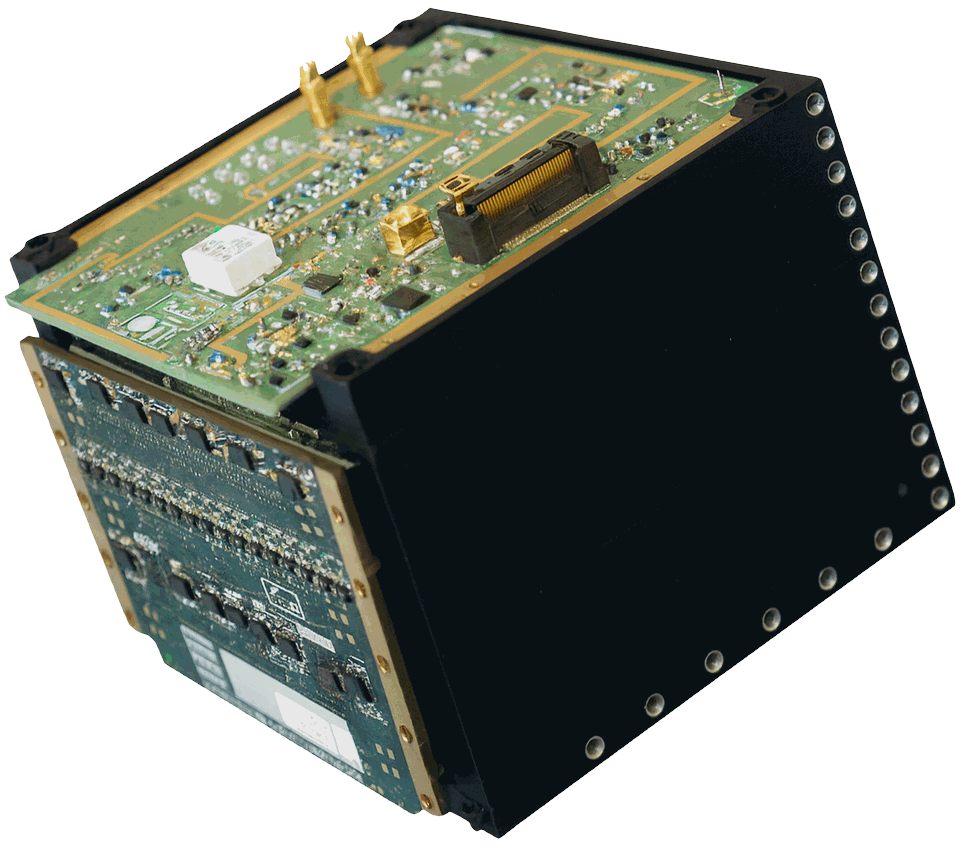
The JuRa stands out as the most innovative component of the Juventas payload, marking the first-ever radar sounding into an asteroid and providing unprecedented insights into its internal structure. Developed collaboratively by us (FSatCom), IPAG in France, EmTroniX in Luxembourg, TUD in Germany and Astronika in Poland, JuRa is highly miniaturized instrument measuring just 9.5×9.5×9.5 cm fitting within a single CubeSat unit and representing the smallest radar system ever flown in space. It operates at low carrier frequency of 60 MHz, allowing deep penetration into the asteroid’s subsurface, potentially up to 100 m depending on the material’s consistency. The radar employs a synthetic aperture design (SAR), transmitting coded signals multiple times to compensate for its limited power consumption. The slow orbital speeds of only a few centimetres per second enable improving the signal-to-noise ratio and 3D reconstruction of radar scans on Earth. JuRa is connected to deployable 1.5 m long perpendicular dipoles by RF switches performing fast transmitter and receiver and wave polarisation switching to gather even more information from the reflected signal. Radar’s resolution is approximately 15 m, sufficient to distinguish between a solid monolith and loosely bound rubble pile, which has critical implications for understanding esteroid formation, Solar system evolution, and planetary defence strategies. It draws heritage from the CONSERT radar on ESA’s Rosetta mission to comet 67P/Churyumov-Gerasimenko, but is adapted for the asteroid environment with radiation-hardened components and software-defined radio (SDR) for signal processing.
FSatCom developed the signal processing IP core for JuRa, the key FPGA module responsible for all-real time radar signal processing. The module sequentially generates modulated signal for X and Y polarizations from configurable pseudo-random (PN) sequence with selectable symbol rate (nominal 20 MHz bandwidth). The transmitted pulse can be window-shaped and filtered upon scientific requirements. Thanks to the very slow relative motion in orbit the reflected signal’s SNR can be improved by heavy accumulation on the receiving side. The receiver section in the IP core coherently accumulates thousands of pulses. Downconversion uses a digital IQ mixer combined with a configurable polyphase decimating filter and successive adaptive framing reduces the sample bit width to compress data volume. The sounding typically consists of bursts of several thousands of PN-based pulses triggered by an internal sequencer which synchronizes receive operations as well and manages RF hardware such as switches and attenuators.
Because JuRa operates in a radiation-harsh environment of deep-space, key control paths are protected against Single Event Effects (SEE) within the IP core in addition to general FPGA radiation protection mechanisms. SEE may corrupt acquired data which generally leads to need of re-sounding, as well as cause harmful missconfiguration of critical RF hardware where protection is inevitable. The configuration memory is protected with continuous parity check and sensitive control logic is triplicated with TMR.